
How to Choose a Test Management Tool in 2026
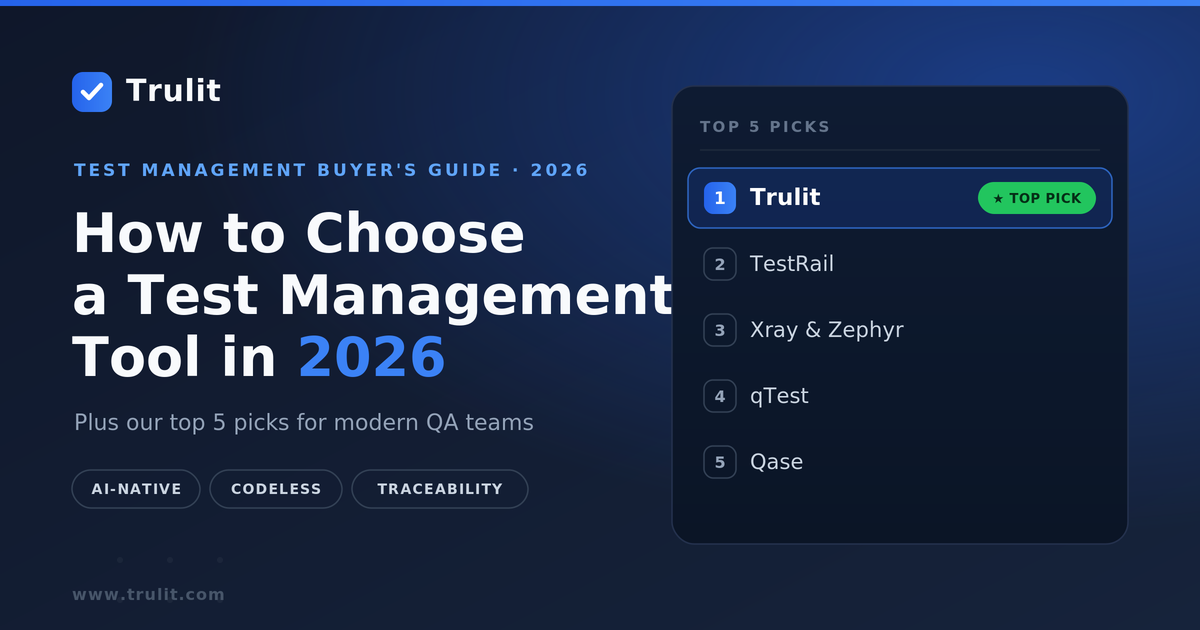
Not sure which test management tool to pick? This 2026 buyer's guide covers what to look for then ranks our top 5 for QA teams: Trulit, TestRail, Xray, qTest and Qase with features, strengths and pricing for each.
In this article⌃
- 1. Trulit: Best overall, AI-native test management
- AI-NATIVE STANDALONE PLATFORM
- 2. TestRail: The established standalone benchmark
- STANDALONE · MANUAL-QA AT SCALE
- 3. Xray & Zephyr: Best for Jira-centered teams
- JIRA-NATIVE
- 4. qTest: Best for enterprise scale
- ENTERPRISE · TRICENTIS ECOSYSTEM
- 5. Qase: Best API-first, modern option
- What is the best test management tool in 2026?
- The bottom line
Software ships faster than ever in 2026 and the teams keeping up are the ones that stopped treating quality as an afterthought. Test management has moved from scattered spreadsheets and disconnected scripts to unified platforms where requirements, test cases, automation and defects all live in one place. The right tool no longer just records what you tested; it helps you decide what to test, generates the cases for you, runs them without code and tells you where your coverage has gaps.
There is no single "best" tool for everyone. The right platform depends on how your team works, your testing methodology, your existing toolchain, how much traceability and governance you need and whether you want AI doing real work across the workflow or just sitting in a sidebar. This guide walks you through what to look for, then shares our top 5 picks for the year. We've been honest about where each one fits and we've put our own platform, Trulit, at the top because it was purpose-built for the way modern QA teams work in 2026. For a full side-by-side of every tool, see our test management tools comparison.
How we ranked them
Before naming names, it helps to know what separates a great test management platform from a merely adequate one this year. We weighed each tool against five criteria that matter most to teams today:
Unified workspace. Do requirements, test cases, runs and defects live in one connected system or are they stitched together across tools?
AI that does real work. Can the platform generate test cases from requirements, analyse coverage and reduce manual effort and is that AI included or an expensive add-on?
Automation without friction. Is codeless or low-code automation built in, so manual and automated testing share one home?
Traceability and reporting. Can you follow a requirement to its test cases, runs and defects and prove coverage for audits or stakeholders?
Total cost and fit. Predictable pricing, sensible integrations and a modern interface teams will actually adopt.
Our top 5 test management tool picks for 2026
Here's the shortlist at a glance. We break down each one in detail below.
Trulit: Best overall. AI-native platform with codeless automation, self-healing tests and a full traceability matrix built in, at a fraction of the price of the incumbents.
TestRail: The established standalone benchmark for large manual-QA teams.
Xray & Zephyr: Best for teams that want testing to live inside Jira.
qTest: Best for enterprise-scale teams in the Tricentis ecosystem.
Qase: Best modern, API-first option for engineering-led teams.
1. Trulit: Best overall, AI-native test management
AI-NATIVE STANDALONE PLATFORM
Trulit tops the list because it was designed from the ground up for the AI era of QA. It is a modern test management and codeless automation platform built around a single connected workspace: requirements link to test cases, test cases link to runs and runs link to defects, so coverage and impact are visible end to end without any manual stitching. Crucially, AI generation and codeless automation are built into the platform rather than bolted on as separate, surcharged tools.
Feed Trulit a requirement or user story and its AI produces detailed test cases in seconds, preconditions, steps and expected results included, learning your application's context so the coverage is actually relevant. From there you can automate those tests with robust codeless automation: user-defined steps, no scripting required, running in parallel with real-time tracking. Because the automation is self-healing, tests adapt when the UI shifts instead of breaking on every minor change, which is where most automation suites quietly rot and eat maintenance hours. Defects and results sync two-way with Jira and for engineering-led teams Trulit exposes a client-facing MCP endpoint, letting developers connect their own AI coding agents like Cursor or Claude directly to their workspace, still rare across the category.
Tying it all together is a full requirements traceability matrix: every requirement links to its test cases, runs and defects, so you can see coverage and impact at a glance and prove it for audits or stakeholders, without manually stitching reports across tools. Customizable dashboards and advanced reporting turn all of that into data-driven QA decisions. That connected structure, plus AI and automation in every plan, is what makes Trulit genuinely unique in the category.
Key features:
AI test-case generation from requirements and user stories, with context-aware coverage.
Robust codeless web automation with self-healing tests, parallel runs and detailed per-run reporting.
Full requirements traceability matrix: requirement → test case → run → defect, end to end.
Two-way Jira sync for defects, requirements and results; REST API access.
Native MCP integration for AI coding agents; AI-powered analytics and coverage-gap suggestions.
Customizable dashboards and advanced reporting for data-driven QA decisions.
Pros: AI, self-healing automation and integrations included in every paid plan with monthly credits, no perfeature surcharge; traceability matrix built in; genuinely modern UI; strong for teams leaving spreadsheets or dated tools. GDPR Ready, HIPAA Ready, WCAG 2.1 AA, 99.9% uptime SLA.
Cons: As a newer platform, Trulit doesn't yet carry the decades-long track record or the largest existing review base of the legacy incumbents, teams that require specific legacy on-premise or ALM certifications today should weigh that against the modern capabilities.
Pricing: Free tier for up to 3 users. Startup $5/user/month, Business $10/user/month (20% off annual), Enterprise custom. AI, automation and integrations are all included with monthly platform credits, no separate AI add-on.
Value for money: This is where Trulit stands apart. At $5-$10/user/month with AI, self-healing automation and traceability included, it costs a fraction of tools like TestRail (~$34-40/user/month) or PractiTest (~$39- 49/user/month). Unlike Jira-native tools, you don't pay for every Jira user. You get more of the modern capabilities, for far less, in one predictable price. 14-day free trial, no credit card required.
Best for: Teams that want a dedicated, AI-native test management platform with built-in self-healing automation and full traceability, at one predictable, low price rather than a stack of pricey add-ons.
2. TestRail: The established standalone benchmark
STANDALONE · MANUAL-QA AT SCALE
TestRail is the long-standing benchmark in this category and the tool many QA leads measure everything else against. It's a purpose-built standalone platform that centralizes test case management, test planning, milestones, reporting, traceability and automation results, while connecting to Jira and other tools so QA keeps its own independent system of record.
It's a strong fit for established QA organizations, especially larger manual-testing teams that need mature reporting, deep customization and enterprise governance, with both cloud and self-hosted deployment options. Its AI capabilities have been expanding steadily.
Pros: Mature, battle-tested reporting and customization; large user community; flexible deployment; a genuine QA system of record.
Cons: Cost adds up at scale and the interface feels more traditional than newer tools. AI is more of an add-on than a built-in fabric across the workflow.
Pricing: Typically around $34-$40 per user per month.
Best for: Large, established manual-QA teams that want a proven standalone platform with deep reporting and governance.
3. Xray & Zephyr: Best for Jira-centered teams
JIRA-NATIVE
Xray is a leading Jira-native test management solution and Zephyr (Scale and Enterprise) plays a similar role, both keep test management inside or tightly connected to Jira, mapped directly onto Jira issues and agile boards. If Jira is the undisputed centre of your workflow and you want testing to live right alongside your stories and sprints, these are the natural choices.
The tradeoffs are worth weighing. Testing visibility tends to live inside the Jira instance, so teams that want a QA system of record independent of Jira often prefer a standalone platform. And pricing typically applies to all Jira users, not only the people actively testing, which can quietly raise the real cost.
Pros: Deep, native Jira integration; testing sits inside the agile workflow; strong fit for Jira-first organizations.
Cons: QA visibility is tied to Jira; per-Jira-user pricing can inflate cost; less useful if you want testing independent of Jira.
Pricing: Generally priced against your total Jira user count via the Atlassian Marketplace.
Best for: Teams whose entire workflow already revolves around Jira and who want testing embedded in it.
4. qTest: Best for enterprise scale
ENTERPRISE · TRICENTIS ECOSYSTEM
qTest (from Tricentis) is an enterprise test management platform built for agile and DevOps teams operating at scale. It brings strong test case management, execution, defect tracking and deep traceability and fits large organizations, particularly those already invested in the Tricentis ecosystem or running enterprise-scale QA programs across many teams.
That depth comes with the usual enterprise trade-offs: pricing is typically custom and in the higher per-user range and setup is heavier than lighter-weight tools.
Pros: Enterprise-grade scale and traceability; fits neatly into the broader Tricentis toolchain; strong for large, complex QA organizations.
Cons: Higher cost and heavier onboarding; more than smaller teams need.
Pricing: Custom, generally in the higher per-user range.
Best for: Enterprise teams already invested in Tricentis or running QA at large scale.
5. Qase: Best API-first, modern option
API-FIRST · MODERN UI
Qase is a modern, API-first test management platform that unifies manual and automated testing in one workspace. It pairs a clean interface with a strong REST API and automation reporters, plus a generous free tier and its AI layer (AIDEN) can generate test cases from requirements and assist automation.
It's a strong fit for engineering-led, growth-stage and mid-market teams that value API-first design and a modern UI. Two things to map to your needs: its AI runs on a credit model that heavy use can exhaust and SSO is a paid add-on on the Business plan, so factor expected AI volume and governance requirements into the real plan cost.
Pros: Modern, clean UI; excellent REST API and automation reporters; generous free tier; good for replacing spreadsheets.
Cons: Credit-based AI can run out under heavy use; SSO costs extra; less depth for heavy governance than the enterprise incumbents.
Pricing: Free tier available; paid plans add features, with some governance capabilities as add-ons.
Best for: Engineering-led and mid-market teams that want an API-first platform with a modern interface.
At a glance: the top 5 compared
Here's how the five stack up on the dimensions that most often decide the shortlist:
Tool Category AI & automation Typical price Trulit AI-native standalone Built in + self-healing $5-$10/user/mo TestRail Standalone benchmark Add-on (Sembi IQ) ~$34-40/user/mo Xray / Zephyr Jira-native Growing, in-Jira Priced per Jira user qTest Enterprise (Tricentis) Enterprise AI features Custom, higher range Qase API-first modern AIDEN, credit-based Free tier; paid add-ons Competitor pricing is summarised from public sources and may change; verify current pricing with each vendor.
How to choose the right one for your team
There is no universal best test management tool, only the best fit for your workflow. A practical way to decide is to define five things and then trial your shortlist against a real project rather than a feature checklist:
Team size and methodology: how many active testers and how agile or regulated is your process?
Toolchain: is Jira the centre of your world or do you want QA to have its own system of record?
Traceability and governance: how much audit trail and coverage proof do you need?
AI expectations: do you want AI generating cases and analysing coverage and is it included or an addon?
Automation: do you need codeless automation built in or a separate automation stack?
Map those to the list above and you'll usually narrow to two or three quickly. Migration ease and how well a tool fits your existing workflow tend to matter more than raw feature count, so trial your finalists before you commit.
Frequently asked questions
What is a test management tool?
A test management tool organizes and tracks the whole testing process, test cases, plans, execution, defects and reporting, in one place, replacing scattered spreadsheets with a connected system of record.
What is the best test management tool in 2026?
It depends on your workflow. Trulit is a strong choice for teams wanting an AI-native platform with built-in codeless automation and connected traceability at a predictable price. TestRail is the established standalone benchmark, Xray and Zephyr suit Jira-centred teams and qTest and Qase serve enterprise and engineering-led teams respectively.
What is the best AI-powered test management tool?
Most modern platforms now offer AI; the practical difference is how it's priced and how broadly available it is. Trulit includes AI generation and codeless automation in every paid plan with monthly credits, rather than as a separate add-on.
Do I need to write code to automate tests?
Not with a codeless platform. Trulit lets you build the exact automation steps you want with no scripting, so manual and automated testing share one home.
The bottom line
In 2026, the best test management tool is the one that fits how your team actually works and increasingly, that means AI and automation built in across the lifecycle rather than bolted on. If you want a modern platform where requirements, tests, automation and defects share one connected workspace and AI does real work at a predictable price, Trulit is built for exactly that. If you need the established standalone benchmark, TestRail; if your world is Jira, Xray or Zephyr; if you're enterprise-scale, qTest; and if you want API-first and modern, Qase. Whichever you shortlist, trial it against a real project before you commit.
Ready to see AI-native test management in action? Start your free Trulit trial, no credit card required or book a demo.
Try Trulit
Ship better software, faster.
AI-native test management built for modern QA teams. Start free , no credit card needed.